In early-20th-century America, two young men bond over a shared love of music. forming a deep connection which will have a lasting impact on their lives in Oliver Hermanus’ period drama The History of Sound.
The songs we collect together
by Chris DrewThe History of Sound
3.0 out of 5.0 starsCAUTION: Here be spoilers
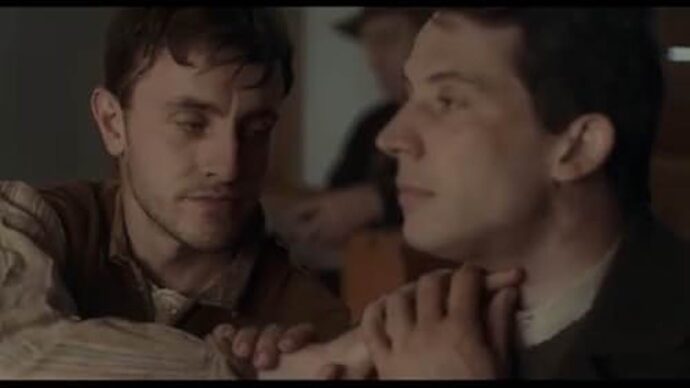
In the Boston Conservatory in 1917 Lionel (Paul Mescal, Hamnet, Aftersun) is entranced in the bar by a familiar song from home being sung at the piano by David White (Josh O’Connor (La Chimera, Challengers)
Not long after there are drunken kisses and then weekly meetings in David’s modest college lodgings.
The burgeoning relationship is abruptly paused when David announces he has been drafted. Lionel (implied to be ineligible for drafting due to his eyesight) movingly gives David a note saying “write, send chocolate, don’t die”.
The narrative then continues in a series of clear sections. The first sees Lionel returning to the quiet modest life with his parents where he works on the farm and then has to deal with a sudden family tragedy.
In 1919 Lionel receives a letter from David outlining a plan for a song-collecting trip. Their train station reunion is quietly joyful before they spend the bulk of their time together on their musical odyssey.
There are many shots of them walking and talking through woods – always looking bracingly cold – moving from settlement to settlement. Some are sceptical of their mission, but David charms many people round and most are fascinated by the cylinder recording process.
In their time alone David becomes increasingly withdrawn and melancholic and is vague about the possibility of a repeat trip the following summer. They wordlessly part at the train station.
Lionel’s next chapter sees him singing in a choir while living in Rome, the warm Italian sunshine a contrast to everything that went before, where he quietly ends a connection with a handsome Italian saying he has been offered a position in England.
While based at Oxford University, Lionel develops a serious relationship with upper-class Clarissa (Emma Canning, feature debut) while still having flashbacks of the trip with David. He is emotionally torn and, when he receives word of his mother’s declining health, he devastates Clarissa by ending the relationship and heading back to the US.
Soon after returning Lionel goes to David’s school in Maine to reconnect only to learn of David’s death and the widow he left behind. Lionel quietly absorbs this devastating news and goes to meet Belle (Hadley Robinson, Little Women).
Revealing she had read Lionel’s letters to David from Italy, she is aware of who Lionel is and his connection to David. Belle is sensitive to him, whilst also being quietly wary, while her husband is totally unaware. She does not have the recording cylinders that Lionel wants to keep.
The final scenes flash forward to the early 1980s with Lionel (Chris Cooper, Adaptation) as an established author looking back on his career while still thinking about David.
A box arrives from Belle containing the cylinders and Lionel discovers an emotional message David recorded for him 60 years later.
Comparisons to Brokeback Mountain are easy to make but warranted; both based on short stories with a connection between two men where they camp together. However, unlike in Ang Lee’s 2005 film, the story is not told from both perspectives. This is very much Lionel’s story; we are not shown David’s life when he is not present with Lionel.
It is a handsomely made and elegant film. The camera coming down the river towards Lionel as a child is a memorable opening and the scenes in Rome are shot beautifully, particularly a stunning shot of Lionel walking alone into an empty square.
It is a film of dirty fingernails, corduroy, constantly overcast skies and endless trees. Shades of brown and tan dominate throughout; the entrance of a character wearing bright red is a jolt both to the story and the visual language of the film.
Naturally the major selling point of The History of Sound is seeing two of the most exciting and in demand actors of their generation together on screen.
Mescal and O’Connor are both excellent, creating both believable chemistry and capturing the underlying feeling of melancholy. Both sing well and are doing fine accent work. With both this and Hamnet this year, Mescal fully cements his title of the reigning king of ‘sad-boy cinema’.
It’s nice to see Oscar-winner Cooper as the older Lionel (although he perhaps does not quite read as old enough to be playing the character in 1980) and he brings a gravitas to the final chapter.
The History of Sound is a worthy entry into the cannon of downbeat gay-themed dramas where characters sadly are not granted the happy resolution so many of their heterosexual counteracts receive.
The History of Sound screened as a UK Premiere at the 2025 BFI London Film Festival and is released in UK cinemas on 23 January 2026.