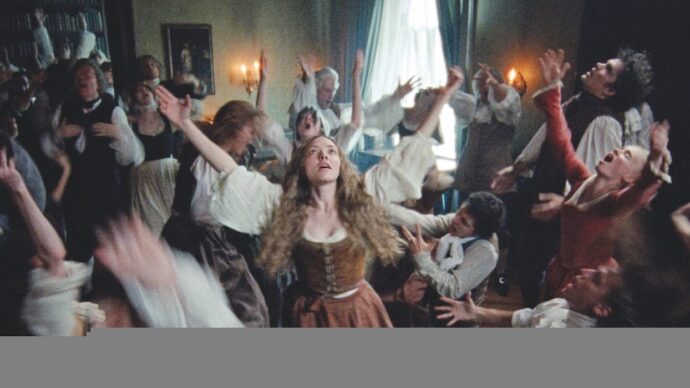
Amanda Seyfried portrays the founder of the Shaker movement in director Mona Fastvold’s historical drama The Testament of Ann Lee, co-written by Brady Corbet.
A Life of Pious Certainty
by Chris DrewThe Testament of Ann Lee
2 stars
CAUTION: Here be spoilers
In 18th-century Manchester we are introduced to the young Ann Lee, a girl having heavenly visions and an early aversion to sex, after witnessing her parents together in bed.
Following two rapid iterations of a younger Ann she soon morphs into Seyfried (Mank) continuing Ann’s commitment to religion followed by her devoted brother William (Lewis Pullman, Top Gun: Maverick).
Immersing herself in the religious community with meetings at the Wardly Society Ann feels a natural affinity to the Quakers’ worshipping rituals of chanting, shaking and singing, soon earning them the name Shakers.
Meeting Blacksmith Abraham (Christopher Abbott, Poor Things) Ann is soon enduring marital sex before losing four babies, each before the age of one.
Sent to the infirmary, Ann comes to the realisation that to be truly faithful it is necessary to give up the sins of the flesh and live a celibate life.
Deepening her faith, she becomes known as Mother Ann and makes it her mission to spread the religion in America. The Shakers face multiple challenges crossing the Atlantic and then setting up a community in the new world.
The production design and costume design are excellent, doing a superb job of recreating the time period.
However, Corbet and Fastvold’s screenplay lacks compelling narrative energy, feeling more like a portrayal of a series of events that happened. One key character is given a surprising off-screen death which could have made for an emotional scene.
There are a number of repetitive beats with Ann’s continued visions and scenes of the Shaker’s passionately and energetically worshipping and singing.
Much of the music is lovely although most of the songs feel incomplete and very similar, however the credit ‘adapted from Shaker spirituals’ shows real authenticity. Seyfried’s Lee gets to sing solo in a few scenes and predictably nails those moments.
There are two positive moments of racial relations with Shakers being deeply shocked and disapproving of slavery when they arrive in New York and later having positive relations with the nearby native community when developing their settlement.
The film is well shot including some beautiful imagery; the light coming through Seyfried’s hair in her prison cell, a burning building ablaze in a later scene as well as the use of natural landscapes.
Seyfried’s committed performance as Lee is the highlight and could lead to the actress receiving a second career Oscar nomination. The one-time mean girl does strong accent work and, in her emotional intensity, convinces as Ann becomes more and more deeply invested in her beliefs.
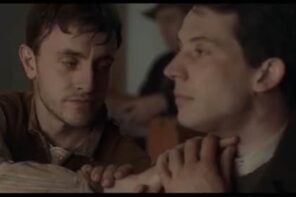
Pullman is solid as Ann’s loyal brother, just about sticking with the accent, but has no character arc, one scene indicating his homosexuality is never revisited. Thomasin McKenzie (Leave No Trace) has even less to do as Ann’s constant friend Mary, although she does make for an effective narrator.
Abbott is dependable as Lee’s husband who stays around for longer than expected while dealing with his enforced celibacy.
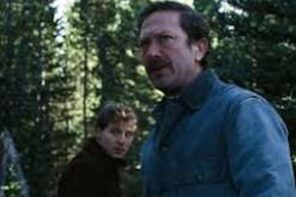
Stacy Martin (The Brutalist) is very strong in the early scenes as Jane Wardly and Tim Blake Nelson (O Brother Where Art Thou?) makes a welcome appearance as the religious leader of a community the Shakers reach.
Slow paced and with a muted colour palette, The Testament of Ann Lee can be a challenging watch but Seyfried in particular makes it worth watching.
The Testament of Ann Lee screened in competition at the 2025 BFI London Film Festival on 11 and 15 October 2025.