After the opening of Oklahoma! renowned lyricist Lorenz Hart has to deal with the success of his former partner Richard Rodgers and his own insecurities in Richard Linklater’s period drama Blue Moon.
A Levitating Melody
by Chris DrewBlue Moon
3 stars
CAUTION: Here be spoilers
Opening in late 1943, Blue Moon begins with Lorenz ‘Larry’ Hart (Ethan Hawke, Training Day) collapsing in the pouring rain and his subsequent death announced over the radio before cutting to events seven months earlier.
Watching the first Broadway performance of Oklahoma! with his mother, Hart cannot take any more and leaves to drink at Sardi’s ahead of the after-show party.
Greeted by bartender Eddie (Bobby Cannavale, The Station Agent) the two reenact a scene from Casablanca, before Hart regales all in the bar with his musings on his career, on Oklahoma! and its lyricist his former collaborator Richard Rodgers.
There is so much energy in screenwriter Robert Kaplow’s crackling dialogue which Hawke sinks his teeth into with relish; furiously rattling off witty barbs and poetic flourishes as Hart rapidly fluctuates between ostentation and self-deprecation.
Bitter that Rodgers is about to get his biggest success without him, the diminutive Hart quips that Rodgers would deliberately work with someone tall (the towering Oscar Hammerstein II) after him.
Hart talks of his admiration for Claude Raines – both short and a leading man – but interestingly Raines usually played the antagonist; a metaphor for the way Hart views himself versus the reality of his life and career.
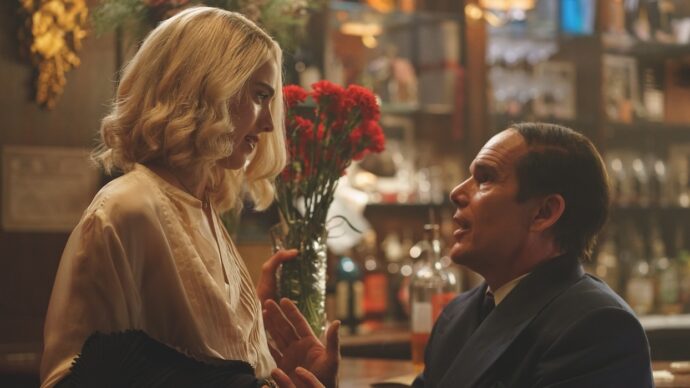
Hart passionately talks of a crush on a 20-year-old woman “my irreplaceable Elizabeth” (Margaret Qualley, The Substance) while also making occasional vague references to himself as a gay man. It is never clear if Hart believes his feelings for Elizabeth are real.
In fact, Hart being delusional is a frequent theme; he repeatedly talks of hosting a huge party later that night which never once feels genuine.
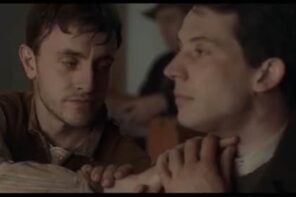
Once Rodgers (Andrew Scott, All of Us Strangers) arrives, Hart joins in the choruses of adoration for the show, but the surprise is Rodgers’ desire to again work with Hart, albeit professionally with routine and discipline.
Hart insists, to a clearly sceptical Rodgers, that he is ready to write and pitches an idea for an original show – inspired by Elizabeth – while Rodger’s wants them to work on a revival. Learning of plans for Rodgers to also continue his burgeoning new partnership with Hammerstein (Simon Delaney, The Conjuring 2) Hart is visibly crestfallen.
Rodgers expresses both deep gratitude and continued frustration towards Hart, pointing out times he had to write lyrics Hart had forgotten while drunk. As Rodgers departs, to the continuing party upstairs, his genuine concerns for Hart’s health and ability to work are evident.
In a much-drawn-out scene Hart borrows the cloakroom to spend time with Elizabeth. He hangs on every word of her prolonged story about another man before she confirms her feelings for him are not romantic.
Contained to a single setting, Blue Moon could feel like filmed theatre – some of Hart’s stories feel ripe for flashbacks which never come – but the screenplay and performances ensure it is thoroughly engaging, combined with strong production and costume design capturing the period.
Reuniting with frequent collaborator Linklater, Hawke is superb as Hart. Balding with a combover, he captures Hart’s passion, disillusionment and evident fluctuations with his mental health while delivering the huge amount of dialogue with aplomb.
Hart’s small stature – he is known to have been about five feet tall – is well depicted through use of forced perspective and, one assumes, some visual effects. One minor character quibble is the dark contact lenses Hawke is saddled with, making his eyes look like two gateways into hell.
As Rodgers, Scott is excellent; smooth and confident, coolly dealing with all the enthusiastic well wishers with a “it’s nice to see you”, whether he knows them or not. His performance makes for a compelling contrast to Hart’s eccentricities, and their scenes together crackle with chemistry and tension.
Qualley brings a brightness and youthful exuberance as Elizabeth, seeing Hart as a mentor figure, unaware of his unrequited feelings while, as Eddie, Cannavale is fun, trading quips with Hart between his concerned looks and attempts to curtail Hart’s drinking.
Both the sparkling screenplay and Hawke’s showcase performance could be recognised throughout Awards Season as Blue Moon takes its place in Linklater’s celebrated filmography.
Blue Moon screened as a UK premiere at the 2025 BFI London Film Festival. Richard Linklater gave a Screen Talk at the LFF on 17 October 2025.